
Yes. A photo of a home for sale that has been edited to add, remove or change something in it needs a note beside it and a way to see the original. That has been California law since January 1, 2026, when Assembly Bill 723 (Chapter 497 of the Statutes of 2025, signed October 10, 2025) took effect as Business and Professions Code section 10140.8.
The rule is the same for every California listing, including homes in Pittsburg, Antioch, Brentwood, Oakley, Concord, Martinez and Bay Point, whether you are selling or buying. It covers virtual staging, which means furniture added by software to a photo of an empty room, and it covers other edits too.
What counts as a digitally altered listing photo?
A listing photo is “digitally altered” when it was changed with photo editing software or artificial intelligence to add, remove or change an element, and the change was made by or at the direction of the broker, the salesperson or a person acting for them (section 10140.8, subdivision (b)). The statute’s own list of elements is long: fixtures, furniture, appliances, flooring, walls, paint shade, hardscape (paved areas and walls outdoors), landscape, facade, floor plans, and things outside of or visible from the property, such as streetlights, utility poles, views through windows and neighboring properties.
A photo does not count when the only changes are lighting, sharpening, tone balance, tint correction, angle, cropping, exposure or other common adjustments that do not change the representation of the real property. The test in the text is whether the edit changes “the representation of the real property.”
| Edit to a listing photo | Counts as digitally altered? | Why |
|---|---|---|
| Furniture added to an empty room (virtual staging) | Yes | The section lists furniture among the elements. |
| Furniture removed from a furnished room | Yes | The section covers removing elements. The California Regional Multiple Listing Service says clearing furniture that will not stay with the home needs the same label and original. |
| Wall paint shade or flooring changed | Yes | Both are named in the section. |
| Brown lawn turned green | Yes | Landscape is named in the section. |
| Utility pole or streetlight removed | Yes | Both are named in the section. |
| Brighter lighting or an exposure fix | No | The section lists lighting and exposure among the common adjustments. |
| Cropping or sharpening | No | The section lists both. |
| Sky replaced with a bluer sky | Not named | The section does not use the word sky. HousingWire reports that its phrase “elements outside of, or visible from, the property” may reach the sky above a roofline, so ask the agent to label it. |
Sky replacement was the most common edit in a large count of listing photos reported in 2026. HousingWire reported on June 24, 2026 on a study by the real estate intelligence company Coraly of just under 40,000 primary listing images from Zillow, Redfin, Realtor.com and Homes.com in the first quarter. It found 10.8 percent (4,330 images) showed signs of digital alteration, more than 90 percent of those altered images had no visible disclosure, and sky replacement made up 69 percent of the altered images. Virtual staging was about 10 percent.
What must the agent disclose, and where?
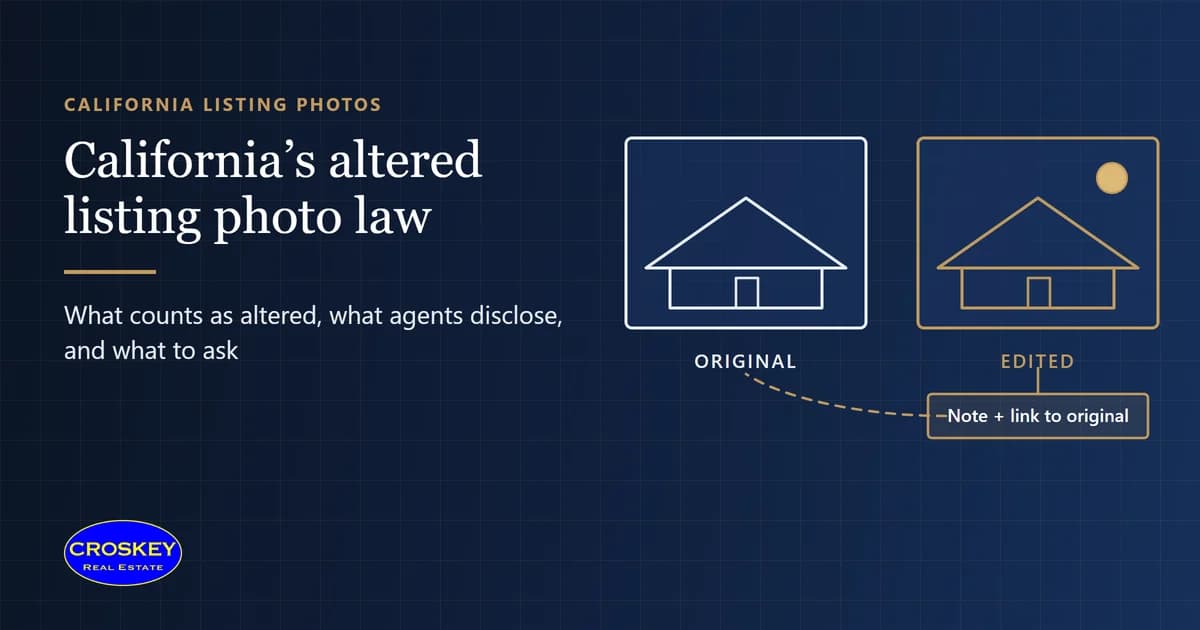
The agent must put two things in the ad: a statement that the image has been altered, and a link, web address or quick response code that leads to a publicly accessible page showing the original, unaltered image and clearly identifying it (section 10140.8, subdivision (a)). The quick response code is one of the three ways the statute allows, which suits a printed flyer that cannot carry a clickable link.
The statute sets four requirements for the statement and the original:
- The statement must be reasonably conspicuous, so a buyer can see it without hunting.
- It must be located on or adjacent to the altered image, not on a separate page.
- It must include language saying the unaltered images can be accessed at the linked website, web address or quick response code.
- If the ad is posted on a website the broker or salesperson controls, the unaltered version of each image must be included in the posting. A link to a public page that clearly identifies the original also satisfies this, and the statement then needs the same “unaltered images can be accessed” language.
“Reasonably conspicuous” is the standard, and the section sets no exact words or type size, so a label in tiny gray type under a photo is worth asking about.
Who does the law cover?
The section names “a real estate broker or salesperson, or person acting on their behalf.” It does not mention sellers, and it does not mention websites or listing portals. HousingWire reports that the law applies to licensees, not the portals that carry listings.
The section sets no separate penalty of its own, and the legislative counsel’s digest of the chaptered bill, which is the official summary printed with it, says the requirements apply to real estate licensees.
The law is not an urgency law.
What do Bay East and the California Regional Multiple Listing Service require?
Both publish rules that took effect January 1, 2026, and both put the original photo right beside the altered one inside the Multiple Listing Service listing. The details differ, so ask which service your home will be listed on.
Bay East’s Rule 11.5.2 requires an agent who submits an altered image to submit the original too, display it immediately after the altered image, and mark the altered image in a reasonably conspicuous way as “altered,” “digitally altered” or “AI altered” (the “AI” stands for artificial intelligence). Its examples of labels include “Digitally Altered” and “Virtually Staged.” Bay East says virtual staging is allowed when labeled, that listing content is handled through the listing agent and broker whoever edited the photos, and that a missing label or original is handled under its Multiple Listing Service rules.
The California Regional Multiple Listing Service’s page Digitally Altered Image Guidance and frequently asked questions requires the original immediately before or after the altered image and a label in the photo description, such as “digitally enhanced,” “digitally altered” or “virtually staged.” It also says agents may not alter real parts of the property, such as wall paint, flooring, cabinets, wall dimensions or landscaping, and may not use artificially generated landscaping images in the Multiple Listing Service.
How are Croskey listing photos edited and linked?
Before listing photos, the home is cleaned, repaired and given its sign and lockbox, so it is ready for photos on the date the broker sets. A set of photos arrives from the photographer as shot, with the light and the angle already looked after. One person on our team adjusts each photo as needed, with settings such as temperature, brightness, contrast, highlights, shadows, whites, saturation and sharpness. Some photos need just a brightness adjustment. One person on our team also blurs very personal items, such as photos on the walls. For social media, each photo goes into a ready-made template with the property details, the company logo and the company’s contact information. The web address almost always goes in the post caption, not on the photo, and for a home for sale it leads to that home’s page on our website. Photos of homes for sale carry no watermark.
As of October 29, 2026, at least 90 percent of our active listings have a Matterport tour, a 3D tour of the home. The photographer captures the scans for the tour, or the broker can.
Our view is that a photo should show the home a buyer will actually get. A buyer who walks in expecting the edited photo meets the real room first. Our guide to selling your Pittsburg home for top dollar puts the position plainly: we use professional photography, and we do not sell a home with pictures of a home it is not.
What should a seller ask the agent before listing?
Ask to see the plan for the photos before any are posted, so you and the agent are working from the same plan. Seven questions to ask:
- Will any photo of my home be edited beyond lighting, exposure and cropping, and who decides what is edited?
- If you use virtual staging, how will each staged photo be labeled, and where will the original sit next to it?
- Where will the link, web address or quick response code to the originals lead, and will it keep working for as long as the listing runs?
- Will anything be removed from the photos, such as power lines, a neighbor’s structure or a view?
- Does any edited photo show something a buyer will not get at closing, such as a greener lawn or a different paint shade?
- Which person at the brokerage reviews the photos before they go live?
- Can I see the full set, originals and edited versions, before the listing is published?
If you have edited a photo yourself, even with a phone filter, tell the agent before it goes anywhere. Bay East’s rule treats listing content, including photos, as handled through the listing agent and broker whoever edited the photos, so telling the agent lets them label it correctly.
What are the other ways to get listing photos?
Relying on the agent’s edited photos is one choice, not the only one. Each alternative changes what you control, what a buyer sees and what you tell the agent.
| Option | What it gives you | What to watch for |
|---|---|---|
| Your own phone photos | You decide what is shown, and you can start today. The light and the angle are yours to look after. | Tell the agent how the photos were taken before they go on the listing, so the agent can decide how they are used. |
| A photographer you hire | Someone whose job is the light and the angle, with the photos arriving as shot. | It is a cost you pay, and the agent still needs to know whether the files were edited. |
| A free photo-editing app | Quick fixes that you control. | A fix that adds, removes or changes something in the room is more than a lighting fix. Tell the agent exactly what you changed, because Bay East’s rule treats listing content as handled through the listing agent and broker whoever edited the photos. |
| Leaving the photos unedited | A buyer sees the room as the camera caught it. | A dim shot can look darker than the room is. Lighting fixes need no note under section 10140.8, so editing the light is a choice, not a requirement. |
| A 3D tour or a visit (for the buyer) | A tour lets a buyer look through the home before a visit, and a visit shows what no photo shows. | A tour is a way to look, so ask whether the listing has one and still walk the home. |
Whichever you pick, ask the agent how the photos will be handled before they go on the listing. That one question, asked before the first upload, settles who edits, who labels and where the original sits.
What can a buyer do when the photos look different in person?
Start by looking for the note and the original, because the law gives the buyer a way to check. Next to any edited photo there should be a statement and a link, web address or quick response code. Then work through these steps:
- Open the link and compare the original to the photo in the ad. Save screenshots with the date and the listing address.
- Ask whether the listing has a 3D tour, and walk it before you visit.
- If a photo shows changes beyond lighting or cropping and there is no note, ask the listing agent in writing which photos were edited and where the originals are.
- Keep the written answer, so everyone is working from the same record.
Whatever the photos say, walk the home and bring your own questions to the inspection. If you are buying on the Highway 4 corridor, our buy page explains how we work with buyers.
What does this mean for the photos of your home?
It means you can decide up front which edits are worth a label. Edits that stay inside lighting, exposure and cropping need no note. Virtual staging is allowed under both Multiple Listing Service rules when it is labeled and the original sits beside it, and the label tells buyers what they are looking at. An edit that changes the home itself, such as a new wall paint shade or a greener lawn, is where the California Regional Multiple Listing Service sets limits.
On the wider question of artificial intelligence, our page on how we use artificial intelligence says it supports our team and that every listing and sale decision stays under the review of our Broker of Record. If you are choosing an agent, ask these questions of every agent you interview, not only the first one who calls, and compare the answers.
If you are thinking about selling, the sell page is where to start, and questions about how photos are handled on your listing can go to the real estate line at (925) 219-8488.
Sources
- California Legislative Information, Assembly Bill 723 (Pellerin), Chapter 497, Statutes of 2025, approved by the Governor October 10, 2025: https://leginfo.legislature.ca.gov/faces/billNavClient.xhtml?bill_id=202520260AB723 (read October 29, 2026)
- Business and Professions Code section 10140.8, added by Statutes 2025, Chapter 497, effective January 1, 2026: https://leginfo.legislature.ca.gov/faces/codes_displaySection.xhtml?lawCode=BPC§ionNum=10140.8 (read October 29, 2026)
- Bill status, showing Chaptered by Secretary of State October 10, 2025 and a non-urgency measure: https://leginfo.legislature.ca.gov/faces/billStatusClient.xhtml?bill_id=202520260AB723 (read October 29, 2026)
- Bay East Association of Realtors, digitally altered photo rule for its Multiple Listing Service (Rules 11.5.1 and 11.5.2): https://bayeast.org/digitally-altered-mls-photo-rule/ (read October 29, 2026)
- California Regional Multiple Listing Service knowledge base, “Digitally Altered Image Guidance & FAQs” (FAQs means frequently asked questions; Rule 11.5.2), shown as published December 18, 2025 and updated October 20, 2026: https://kb.crmls.org/knowledgebase/digitally-altered-image-guidance-faqs/ (read October 29, 2026)
- HousingWire, article of June 24, 2026 on altered listing photos that go undisclosed, reporting a Coraly study: https://www.housingwire.com/articles/most-ai-altered-listings-go-undisclosed-california-law-bans-it/ (read October 29, 2026)
- Croskey Real Estate pages: https://croskeyrealestate.com/sell, https://croskeyrealestate.com/buy, https://croskeyrealestate.com/how-we-use-ai and https://croskeyrealestate.com/how-to-sell-your-pittsburg-home-for-top-dollar (read October 29, 2026)
This article is legal information, not legal advice, current as of October 29, 2026. Croskey Real Estate is a licensed California brokerage, not a law firm. Rules differ by Multiple Listing Service and by listing, and laws change. Read Business and Professions Code section 10140.8 at the California Legislative Information site, and confirm what applies to your listing with your agent, the Department of Real Estate or an attorney before you act.
Frequently asked questions
Do I have to disclose virtual staging in a California listing?
Yes, the agent does. Under Business and Professions Code section 10140.8, a broker or salesperson who uses a digitally altered image in a home-for-sale ad must add a reasonably conspicuous statement on or next to the image saying it was altered, plus a link, web address or quick response code to the original. Adding furniture to a photo is named in the statute, so virtual staging is covered. Bay East and the California Regional Multiple Listing Service both allow virtual staging when it is labeled and the original is shown beside it.
Is brightening my listing photos considered altering them?
No, as long as the edit does not change what the property shows. The statute excludes images where only lighting, sharpening, tone balance, tint correction, angle, cropping, exposure or other common adjustments are made that do not change the representation of the real property. The test in the text is whether the edit changes “the representation of the real property.” A brighter photo of the same room is fine. A different wall paint shade is not a common adjustment.
What do the rules say about labeling an altered listing photo?
The rule asks agents to put a note beside an altered photo and a way to reach the original. The section sets no separate penalty of its own, and the bill’s official summary says the requirements apply to real estate licensees. Each Multiple Listing Service has its own process: Bay East says a missing label or original is handled under its listing rules, and the California Regional Multiple Listing Service says its compliance staff contact the agent to correct it, starting with a warning the first time.
Can I edit my own listing photos as the seller?
The statute defines a digitally altered image as one created by or at the direction of the broker, the salesperson or a person acting for them, and it names licensees, not sellers. Bay East’s rule treats listing content as handled through the listing agent and broker, regardless of who created or edited the photos. If you edit a photo, tell your agent before it is used so it can be labeled with the original beside it.
Where can a buyer find the original, unaltered photo?
In the same place as the note. The statement next to the edited image must say the unaltered images can be reached at a link, web address or quick response code. If the ad is on a website the broker or salesperson controls, the unaltered version must be in the posting itself, or the posting must link to a public page that clearly identifies the original. In a Multiple Listing Service listing, the original sits immediately after the altered photo under Bay East’s rule and immediately before or after it under the California Regional Multiple Listing Service’s rule.
Does the law apply to Zillow, Redfin and other listing sites?
The section names real estate brokers, salespersons and people acting on their behalf. It does not mention websites or portals, and HousingWire’s article says the law applies to licensees, not portals. The agent who puts the photo in the ad is the person the statute addresses, so the note should come from the listing side.
- Educational Series